
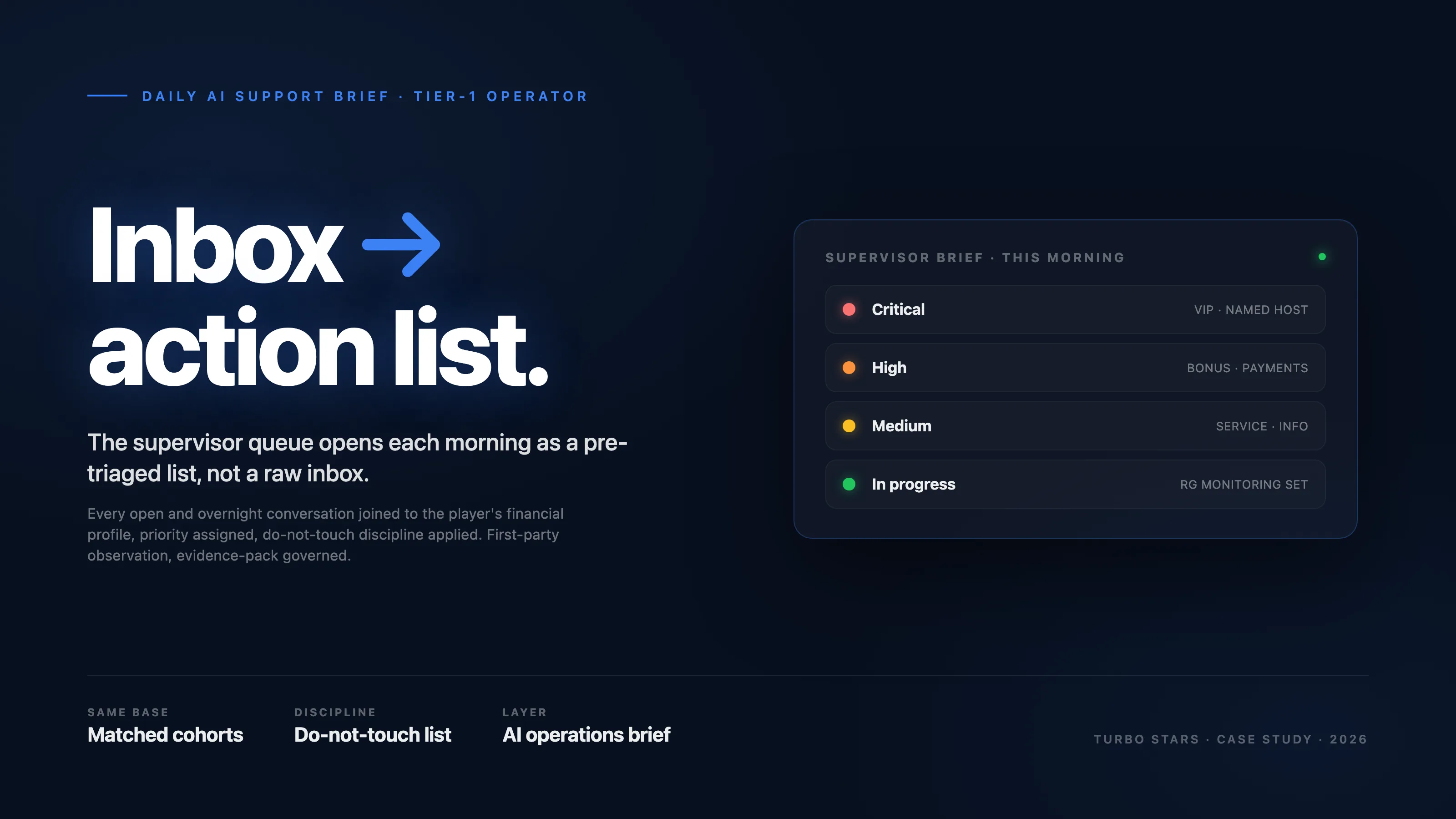
The brief is the join layer that sits on top of the operator's existing Intercom, back office, payments and bonus stack. Every morning, before the shift starts, it processes the full support queue, attaches the player's financial and RG profile to each open thread, and hands the supervisor a prioritised four-step action plan with an eligibility check first. On matched 30-day pre-brief vs post-brief cohorts on the same operator, retention of players who contacted support increased by 7 pp; on the VIP subset the lift was 12 pp.
How to read the metric: pp denotes percentage points — the absolute change on a percentage scale. A shift from 60% to 67% is +7 pp, not +7%. The two figures below are absolute-scale movements, not relative growth.
Basis: Matched 30-day pre-brief vs post-brief cohorts of players who contacted support, controlled for comparable calendar periods on the same operator. Directional first-party observation from the operator's back-office data; cohort sizes, retention definitions, exclusions and source snapshots are disclosed in the NDA evidence pack. Anonymised · not an industry benchmark, SLA or universal outcome.
The challenge — a structural tooling gap around the support queue
The operator ran a mature support setup on a modern stack: a live Intercom queue, a full-featured back office with the player's financial profile, a payments engine and a bonus engine that supervisors could query on demand. The gap was structural: none of these systems natively joined the player's financial profile, RG signals and open conversation thread into a single prioritised view before a supervisor decided.
Every escalation started with a manual reconstruction — pulling the profile from the back office, checking the payment system for transaction history, finding the open Intercom thread, reading through a 16-to-32-message dialogue to locate the actual dispute. That reconstruction took 8–15 minutes per ticket before any decision was made.
High-value players — lifetime deposits of €10–12k, CSAT scores of 1/5, explicit threats of public complaint or chargeback — sat in the queue for hours behind a generic first-line reply, because prioritisation ran on ticket age, not player value. By the time a supervisor reached them, the issue had already escalated into a formal complaint and the player had formed a settled opinion of the brand.
Triage was also one-size-fits-all — a consequence of the tooling gap, not of the team. A VIP with €12k in lifetime deposits and a tilt-driven accusation of rigged games received the same priority as a €28 account asking about penny slot bet sizes. RG signals — a player who lost significant amounts in a single session, used language of desperation, had zero withdrawals in the history — were visible in the data but required someone to pull them across systems. Promotional flows occasionally reached complaint-open or RG-adjacent accounts because the promo engine and the support system did not share state.
What the brief does — a join layer on top of the existing stack
Every morning, before the supervisor logs in, the brief processes the operator's full support queue. It reads every open and overnight conversation, joins each to the player's financial profile from the back office — lifetime deposits, withdrawals, 90-day GGR, bonus rate, active days — identifies the type of dispute and assigns a priority level. The workflow sits on top of the same AI operations brief that runs the morning meeting for the wider organisation.
For each escalation, the brief produces a four-step supervisor action plan:
- Eligibility check. RG and complaint-open signals are assessed first. If either is live, no recovery gesture is proposed — only a compliance-appropriate response path.
- Contact strategy. The right channel and response window are assigned — for example, a named VIP host within two hours for Critical cases, not the shared support mailbox. The VIP operations cockpit is the per-manager surface for these cases.
- Verification. The brief specifies what must be checked in Payments, Bonus or the player history before a decision is made.
- Next action. Where eligible, a proportionate recovery gesture is recommended, calibrated to the player's bonus rate and recent loss profile, followed by a defined follow-up checkpoint and RG observation criteria. When a churn signal fires alongside the ticket, the recovery gesture is tuned by the same win-back engine that runs on the VIP base.
The brief is as much a discipline of not touching the wrong players as touching the right ones. Accounts flagged as RG-adjacent, complaint-open or Closed are removed from every promotional flow automatically.
🔴 2 Critical · 🟠 3 High · 🟡 3 Medium
🔴 4 Critical · 🟠 4 High · 🟡 3 Medium
Example brief output — Critical VIP escalations surfaced on 12 August 2026
Results — by the numbers
- → Supervisor time to first substantive action on Critical cases shortened from 3–6 hours to under 2 hours — the brief arrives before the shift and the reconstruction is already done.
- → By design, the post-brief workflow suppresses every promotional flow into complaint-open, RG-adjacent and Closed accounts. Verified sends are auditable in the operator's outbound-communication logs.
- → CSAT 1/5 cases with a personal supervisor response reached same-day for the VIP Critical tier, up from ad-hoc pre-brief handling.
Evidence status: first-party case claims pending a governed evidence pack with cohort dates, definitions, denominators, exclusions and source snapshots.
Every morning we used to spend the first hour figuring out who the player even was. Now we open the brief and the first thing we read is: here's the player, here's what happened, here's what to say and what not to say. We're in the conversation before the player gives up.