
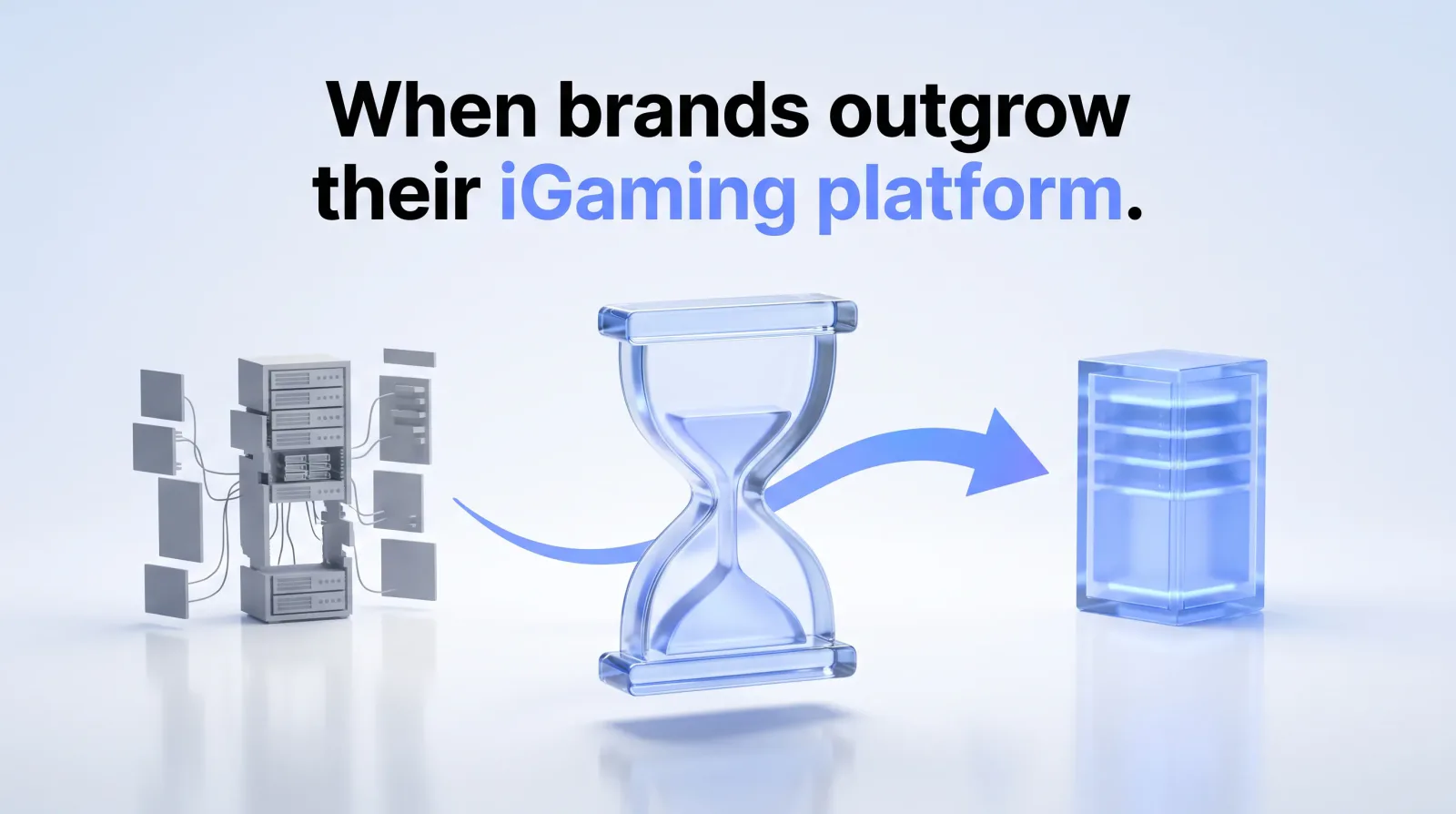
A brand should migrate its iGaming platform when it hits one of three ceilings — cost (unit economics stop improving with scale), product (the vendor can't ship what the growth plan needs), or integration (new PSPs, studios or KYC providers take six months to plug in). Any two of those signals together, and staying is more expensive than moving. The real question is not how to migrate — it is what to move to, and whether it grows when you grow.
The conversation around iGaming platform migration is almost always framed backwards. Vendor pitches focus on migration mechanics — dual writes, cut-over playbooks, rollback plans. That framing assumes the operator has already decided to move and just needs an execution partner. In practice, most brands stay on a platform they've outgrown for another year or two because the decision is unclear, not the execution.
This piece walks through the three signals brands actually recognise when it's time to move, why building a proprietary stack has stopped being the mature answer, and what a revenue-share platform lets a growing operator do that a capex commitment never will.
Three signals a brand has outgrown its iGaming platform
None of these are technical. They are commercial constraints that show up on the P&L or in the roadmap review, not in the engineering standup.
1. Cost ceiling
The first signal is unit economics that stop improving with scale. A platform priced for a $2M/month brand should offer better take-rate for a $20M/month brand — otherwise the operator is subsidising the platform's inefficiency. When quarterly platform costs grow faster than GGR, the ceiling has been hit. A migration to a platform with a real volume curve pays for itself in one to two quarters.
2. Product / feature ceiling
The second signal is a roadmap gap the current vendor can't close. Prediction markets, native cross-sell across sportsbook and casino, in-house AI personalisation, a large game aggregation layer with major studios — these are features the operator's growth strategy now depends on. If they aren't on the vendor's committed roadmap for the next two quarters, the operator is capped at whatever the vendor decides to build. Not a technical problem; a strategic one.
3. Integration ceiling
The third signal is integration friction. Every new payment method, KYC provider, game studio, or affiliate tool adds a project on the vendor's queue. If a new PSP takes six months to plug in — or if a specific game studio "isn't on the roadmap" — the operator's ability to launch a new market or vertical is bottlenecked at the platform layer. Growth-market ambition (LATAM, Africa, Asia) hits this ceiling first because those markets need specific local rails.
Any single signal is a call to renegotiate. Two of them together usually mean it is cheaper to migrate than to keep pushing against the platform.
Why "just build your own" stopped being the answer
The default response for brands hitting the ceiling used to be: build in-house. Assemble a stack from best-of-breed vendors, keep control, own the roadmap. In 2020–2022 this was defensible. In 2026 it isn't, for two reasons.
- The capex is real. A serious in-house iGaming stack — PAM, wallet, CRM, bonus engine, KYC orchestration, game aggregation, sportsbook — is a $5–15M build over 18–24 months before first GGR, and $2–4M/year to maintain. Every dollar spent on infrastructure is a dollar not spent on player acquisition. Brands that took this path in 2021 are now selling those platforms or licensing them out to defray cost — because the return on infrastructure spend is smaller than the return on marketing spend.
- The talent economics inverted. Hiring and retaining 30–50 platform engineers who understand real-time wallet, sportsbook trading, and regulator-specific compliance costs more in salary and rebuilds than paying a platform provider a revenue share. The engineers are also chasing more interesting problems elsewhere — building yet another wallet is not a career highlight.
The mature move is: use a platform whose entire business is being a platform, and negotiate a commercial arrangement where the platform grows when the brand grows.
Revenue share as the growth-aligned commercial model
The commercial structure that most naturally aligns platform and operator is revenue share on GGR. The platform gets paid when the operator generates revenue; if the operator's growth stalls, the platform's economics do too. Both sides have skin in the game.
Concretely, a rev-share model unlocks three things a fixed-fee or licence-fee model does not:
- Zero capex to launch or migrate. No seven-figure licence, no upfront integration invoice. The operator's cash goes into media, brand, and player acquisition — where the return curve is highest.
- Platform incentive to make your brand grow. The platform's biggest customers pay the platform the most, so the platform's product and engineering effort follows the operators who are scaling. A brand that's growing gets more platform attention, not less.
- Alignment on retention, not just acquisition. Platform revenue depends on the operator holding players — not just onboarding them once. That aligns AI-driven retention, cross-sell, and responsible gaming investment with the operator's LTV.
The Turbo Stars platform operates on this model across LATAM, Europe, Africa and Asia. Operators join without a capex cheque and scale on shared economics. That commercial structure is not a nice-to-have — it is the reason a growing brand can move without a board fight over capital allocation.
What a "better platform" actually delivers
A platform worth migrating to is not the one with the slickest sales deck. It is the one whose product depth, content, and integrations mean the operator's roadmap stops being bottlenecked at the platform layer.
Concretely, the three things a growing brand should benchmark on any target platform:
| Dimension | What to check |
|---|---|
| Content depth | Total game count across major studios, native sportsbook coverage (leagues + markets + in-play depth), and — increasingly — prediction markets / event-trading catalogue. A brand launching in a new market needs the local top titles ready on day one. |
| Integration breadth | Number of live PSPs by region (LATAM: PIX, Boleto, OXXO, SPEI; Africa: mobile-money rails; Asia: local UPI/local rails), KYC providers wired natively, and affiliate/CRM tools with production integrations. The right benchmark is not "is X available" — it is "how long does it take to enable X for a new market". |
| Product roadmap you actually get | AI-driven personalisation across products, native cross-sell wallet, single KYC across verticals, native prediction markets, self-serve GEO expansion. These belong in the platform, not in the operator's future backlog. |
The single-integration architecture — sportsbook, casino, prediction markets and the Turbo Aggregator on one shared wallet — is what lets an operator lead with any vertical, cross-sell into the others from day one, and never ask a player to re-register or re-deposit. Adding a new market post-migration is a self-serve operation on the operator side, not a provider ticket.
Case study: a Tier-1 brand that outgrew its previous platform
In Q1 2026, a European Tier-1 operator moved to Turbo Stars. The reason for the move was neither technical curiosity nor a vendor dispute — it was a straight-forward business decision:
- Their previous platform's take-rate had not improved as they scaled from Tier-2 to Tier-1 volume.
- Prediction markets and native cross-sell were not on the incumbent's roadmap, and their growth thesis for the next two years depended on both.
The migration itself was completed in 14 days — wallet, CRM, content, and sportsbook — with no player-visible disruption. But the migration was not the point. The point was what the operator could do on day one after cutover: cross-sell across products on a shared wallet, launch a new country without a provider request, and turn on native AI personalisation for churn and bonus optimisation.
What to look for when evaluating an alternative platform
A checklist that separates growth-aligned platforms from repriced legacy vendors:
- Commercial model: revenue share on GGR, no upfront licence, no six-figure integration invoice.
- Content on day one: the specific studios and sports coverage the brand needs, ready without a new integration project.
- Integration self-service: new markets, PSPs, and KYC providers enabled by the operator without a platform ticket.
- Product roadmap alignment: AI personalisation, native cross-sell wallet, prediction markets — in production, not in a slide.
- Same team ships and supports: the engineering team that built the platform is the team that responds when something breaks. No vendor chain, no SLA arbitrage.
A brand that has outgrown its platform has usually spent 12 months quietly pushing the current vendor for these things. If the answers are "on the roadmap, TBD," a serious evaluation of alternatives has already paid for itself.
Where Turbo Stars fits
Turbo Stars is a full-cycle B2B iGaming platform: sportsbook, casino, prediction markets, and an aggregator on a single shared wallet, through one integration. The commercial model is revenue share on GGR — operators launch and scale without capex and without licence-fee friction. The engineering team that maintains the platform is the same team that ships new markets, PSPs, and product features week to week. That structure is what lets a growing brand plan a two-year roadmap without waiting for a vendor queue.
If your platform is holding growth back, the useful next step is a scoped conversation with the operator team — not a technical migration meeting. Migration is quick. Deciding where to move is what actually determines the next two years of the business.
Frequently asked questions
How do we get CFO or board approval for an iGaming platform migration?
The financial case rests on three numbers: current platform's take-rate over the last four quarters (is it improving or degrading with volume?), a two-year forecast of foregone GGR from features the current vendor can't ship (cross-sell, prediction markets, AI personalisation), and the cost of a proprietary build alternative ($5–15M capex + $2–4M/year opex vs zero capex on rev-share). Frame the decision as 'capex-free growth acceleration', not 'technology upgrade'. If migration removes even one quarter of blocked GGR expansion, it usually pays back within the first two quarters post-cutover.
What happens to our existing player accounts, balances and bonus liability during migration?
Every open player balance, every bonus balance, every pending withdrawal, and full player history (including KYC verification state and regulator-specific compliance flags) is preserved across cutover. Wallet migration runs both stacks in parallel with daily balance reconciliation until every player balance matches to the cent, then reads flip. Bonus liability follows the same parity approach so no active bonus is invalidated or double-credited. The player experience is a normal login — no re-registration, no re-KYC, no re-deposit.
Can we run a proof-of-concept before committing to full migration?
Yes — the standard entry point for Tier-1 evaluations is a scoped POC in a non-critical market. A single regulator jurisdiction or a soft-launch brand gets migrated onto Turbo Stars first, run for a defined period with parallel measurement (GGR-per-player, session engagement, cross-sell conversion), then either expanded to the rest of the estate or reverted. The POC validates take-rate improvement, content depth and integration speed against the current stack on real traffic, not on a demo deck.
What if we're locked into a contract with our current platform vendor?
Vendor contracts with meaningful exit penalties usually amortise across 6–18 months. In the same window, quantifying the opportunity cost of staying — foregone GGR from missing product capabilities, subsidised take-rate, delayed market launches — often exceeds the penalty by a factor of three to five. The productive move is to timeline migration for immediately after the earliest exit window (or the next contract renegotiation), and use the intervening months for the POC and full data-mapping work. Nothing is worse than staying an extra year on principle after the numbers have already made the case to move.